Caloris
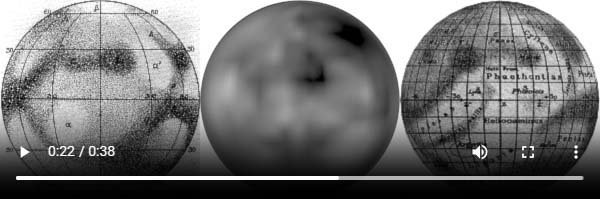
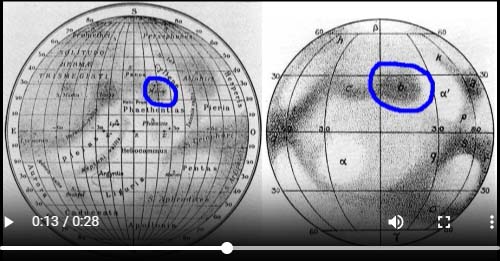
Compare maps made by astronomers Rudaux and Antoniadi with images from the Messenger spacecraft. Can you identify any real features? In these inverted views, South is up. The Messenger image has been degraded to simulate the resolution of Rudaux’s telescope.
The light and dark areas on the right limb were first compared with an Arabic numeral 5 by Schiaparelli, an earlier observer. They surround a feature labeled “Pentas” by Antoniadi. We now recognize that this is Caloris, one of the largest impact basins in the solar system.
Tolstoj is a 240-mile wide, ancient impact crater. It was named after author Leo Tolstoy. The albedo feature Solitudo Maiae may indicate this crater on maps from a century ago. Tolstoj is only about two kilometers, or 1.2 miles, deep. This is much less than the depth of lunar basins of similar size. It indicates that Tolstoj probably has relaxed from its shape right after the impact that made it.
Beethoven is a 400-mile diameter crater, about the size of Arizona, and was named after the famous musical composer. Unlike many basins of similar size on the Moon, Beethoven is not multi-ringed. There are no wrinkle ridges or areas of depressed crust like those in Caloris.
Beethoven is about 2.5 kilometers or one and a half miles deep. This is significantly less than the depth of lunar basins of similar size. It indicates Beethoven probably has relaxed from its shape after the impact that made it.
Weird / Chaotic Terrain
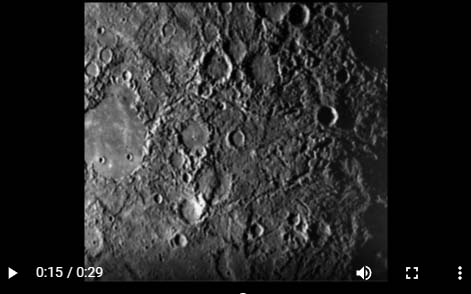
The impacting body that formed Caloris Planitia is estimated to have been at least a hundred kilometers, or 62 miles, in diameter. At the exact antipode, or opposite side, of Mercury is a large area of hilly, grooved terrain with few small impact craters. It is known as chaotic terrain, or “weird terrain”.
It’s thought to have been created as seismic waves or ejected matter from the impact converged on the opposite side of the planet.
 above.